Veolia: Winter Water Termination Program

Veolia: Winter Water Termination Program: Work with us to keep your Water Flowing

https://mywater.veolia.us/toms-river/financial-assistance-programs-new-jersey

https://www.nj.gov/dca/dhcr/offices/wintertermination.shtml

In accordance with NJAC Section 14:3-3A. 5. Veolia has implemented a Winter Termination Program to prevent service discontinuation for eligible residential customers receiving water from November 15th through March 15th. Service cannot be disconnected during this period for eligible customers.

Who is eligible?

  1. Recipients of benefits under the Lifeline Credit Program.
  2. Recipients of benefits under the Federal Home Energy Assistance Program (HEAP) or certified as eligible therefore under standards set by the New Jersey Department of Human Services.
  3. Recipients of Temporary Assistance to Needy Families (TANF).
  4. Recipients of Federal Supplemental Security Income (SSI).
  5. Recipients of Pharmaceutical Assistance to the Aged and Disable (PAAD).
  6. Recipients of General Assistance (GA) benefits.
  7. Recipients of the Universal Service Fund (USF).
  8. Persons unable to pay their utility bills because of circumstances beyond their control.
  • Eligible customers must contact the Collections Department at 1-855-862-6076 to self-certify. Customers will be required to establish either a budget plan or payment plan with a down payment.

Your service will not be discontinued if you can show the utility that you are making a good faith effort to pay. If you fall too far behind on your monthly payments during the winter, your water service will be discontinued after March 15th or later if weather conditions require extension of the protection program. Customers who have the ability to make a good faith payment but refuse to do so shall be referred to the Board of Public Utilities for a determination.

If your utility determines you are not making a good faith effort and they notify you that they will discontinue service, negotiate with them again. If you and the utility cannot agree, the utility shall refer the dispute to the Board of Public Utilities for determination. You may also contact the Board of Public Utilities at 1-609-341-9188 or toll fee (in New Jersey) 1-800-624-0241.

Need Assistance Paying your Utility Bills?

You may be eligible for these programs:

Veolia Cares https://cares.veolia.com/ or call 888-942-8080.

NJ Shares 1-866-NJSHARES (657-4273) or njshares.org

The Low Income Energy Assistance Program (LIHEAP) 1-800-510-3102 or energy assistance.nj.gov

The Universal Service Fund Program (USF) 1-800-510-3102 or energyassistnace.nj.gov

NJ Lifeline Credit Program & PAAD 1-800-792-9745 or aging.nj.gov

Page Grant 1-855-465-8783 or njpoweron.org

Additional Resources:

Department of Community Affairs: 1-800-510-3102 or 1-866-240-1347

New Jersey Board of Public Utilities: http://www.nj.gov/bpu/assistance/programs

Veolia Collections Department 1-855-862-6076

*Footnote: this information comes directly from a Veolia Water mailer and I give them full credit on the copyright and information on this. This is there direct mailer to customers that I want to share with everyone. I have never used the service so I have no opinion on it one way or another.

Please call the Veolia 1-800 number for more information.

Posted in Bergen County NJ Programs, Clean Water Programming, Uncategorized | Tagged , , , , , , , , , , , , , , , , , , | 1 Comment

Arise/Standing Wheelchair-Phoenix Medical Systems

Arise/Standing Wheelchair-Phoenix Medical Systems

https://www.phoenixmedicalsystems.com/assistive-technology/arise-standing-wheel-chair

(From the Phoenix Medical Systems pamphlet)

Arise is a manual wheelchair with an inbuilt feature that allows the user to independently rise to a
standing position. A majority of users of conventional wheelchairs lack control over their lower limb musculature and require considerable effort, assistance and/or aids to get to a standing position. The ability to attain and maintain a standing position is greatly beneficial to the health, self-esteem and sense of wellbeing of a wheelchair user.

https://assets.tina.io/c663584b-949a-433f-90e2-2216d1acfce1/Arise.pdf

Research has shown that at least 30 minutes of standing, preferably 5 minutes of standing six times a day, is essential for the wellbeing of a wheelchair user. In addition to enabling the individual to perform numerous tasks that she or he might not be able to perform while in a sitting position, a standing posture provides multiple health benefits such as improving the blood circulation of the lower limbs, controlling bowel movements, healing pressure sores, preventing muscle spasticity and contractures and improving respiratory function, skin integrity and bone mineral density. Standing also offers the user an increased sense of psychological wellbeing and social significance.


The Arise Standing Wheelchair by Phoenix Medical Systems

Arise is a completely mechanical standing wheelchair. While it functions like a regular wheelchair in
facilitating mobility, it further allows users to raise themselves into the standing position with the muscle power of the arms. When Arise is optimally adjusted, the effort required to operate the standing mechanism is only about the same as the effort required to propel the wheelchair. In addition to typical safety features such as straps and guards, additional locking mechanisms are incorporated in Arise to prevent accidental activation and to ensure the stability of the user when standing. Affordability has been achieved by creating a novel mass manufacturable mechanical design that incorporates the customizability required to accommodate a wide range of wheelchair users.


Unlocking Lives Uses:


Arise is designed to be used both outdoors and in indoor environments

YouTube video from Phoenix Medical System

YouTube on the product

Disclosure: I got this information directly from the Phoenix Medical Systems website and I give them full copyright credit on this information. I have never used this product before so I have no opinion on it whether it is good or bad. I thought this was a very innovative product that could help many people across the world and wanted to bring it to patients who might benefit from a wheelchair like this.

Posted in Disability Programming, Health and Life Support Services, Home Care Programs, Men's Programming, Senior Disability Programming, Senior Services, Support Services for Seniors, Uncategorized | Tagged , , , , , , , , , , , , , , , , , , , | 1 Comment

SNAP: Down to Earth Farmers Markets-You can shop at the Farmer’s Market with SNAP EBT

SNAP: Down to Earth Farmers Markets-You can shop at the Farmer’s Market with SNAP EBT

SNAP-Supplemental Nutrition Assistance Program

Important Information:

*Vendors will not give change for tokens or coupons.

*Tell the Manager what token denominations will be useful to you when you make your withdrawal.

*Tokens do not expire.

*Coupons do expire, so check the expiration date on any coupon you do not use right away.

*Only use Down to Earth tokens in our Farmer’s Markets.

*The Manager will be happy to answer your questions about using tokens and coupons or about the farmers market in general.

At the Farmers Market:

Our Mission is to provide a marketplace where small, local farms and food makers can sell directly to consumers.

You will only see fruits and vegetables grown in the New York area in our markets. The selection changes seasonally, so come back at least every few weeks to see what’s new!

SNAP EBTY can be used for:

*Fruits and Vegetables

*Edible plants

*Breads and seasonings

*Meats, Seafood and Eggs

*Cheese and other dairy products

*Pickles, jams, nuts, coffee beans, and tea leaves.

Fresh Connect Checks can be used for:

*Everything that SNAP can purchase.

Health Bucks can be used for:

*Fresh Fruits and vegetables

FMNP Checks can be used for:

*Fresh fruits and vegetables

Learn more about us on:

https://www.facebook.com/DowntoEarthMarkets/

https://www.instagram.com/downtoearthmkts/?hl=en

Here’s how: Find a Manager at the Down to Earth Markets tent:

*Tell the Manager how much you would like to spend-remember that you can come back to withdraw mor but we can’t refund unspent tokens.

*Swipe your EBT card using our mobile terminal (or have the Manager enter your card number) and enter your pin.

*The Manager will give you tokens in the amount that you asked to withdraw and bonus coupons to spend in the farmers market (Fresh Connect in Westchester or Health Bucks in NYC)

*Head out into the Farmers Market to shop!

SNAP EBT cards, Fresh Connect Checks and WIC and Seniors Farmers Market Nutrition Program checks are welcome at all of our farmers markets:

Brooklyn: Park Slope (Sundays, year around) and McGolrick (Sundays)

Manhattan: Chelsea (Saturdays) and Morningside Park (Saturdays, year-round)

Queens: Queens Botanical Garden (Fridays) and Cunningham (Sundays)

Westchester: Ossining (Saturdays, year around), Larchmont (Saturdays), Mamaroneck (Saturdays, winter only) Rye (Sundays) and New Rochelle (Fridays)

*Health Bucks also distributed & accepted.

Bloggers Note: This information was taken directly from the Down to Earth Farmers Markets pamphlet and I give them full credit for this information. I have attached the Facebook and Instagram accounts so that people can visit their sites. I have never used their program so I have no opinion on it.

Posted in Federal Nutrition Programs, Food and Nutrition Programming, Men's Programming, Uncategorized | Tagged , , , , , , , , , , , , , , , , | 1 Comment

The Hospital from Home Program at Hackensack Medical Center in Hackensack, NJ

I wanted to share with all of you this wonderful program from Hackensack Medical Center in Hackensack, NJ. While you must past an eligibility for this program, I think this innovation will change the way hospital visits will work in the future for certain patients.

Welcome to Hospital From Home

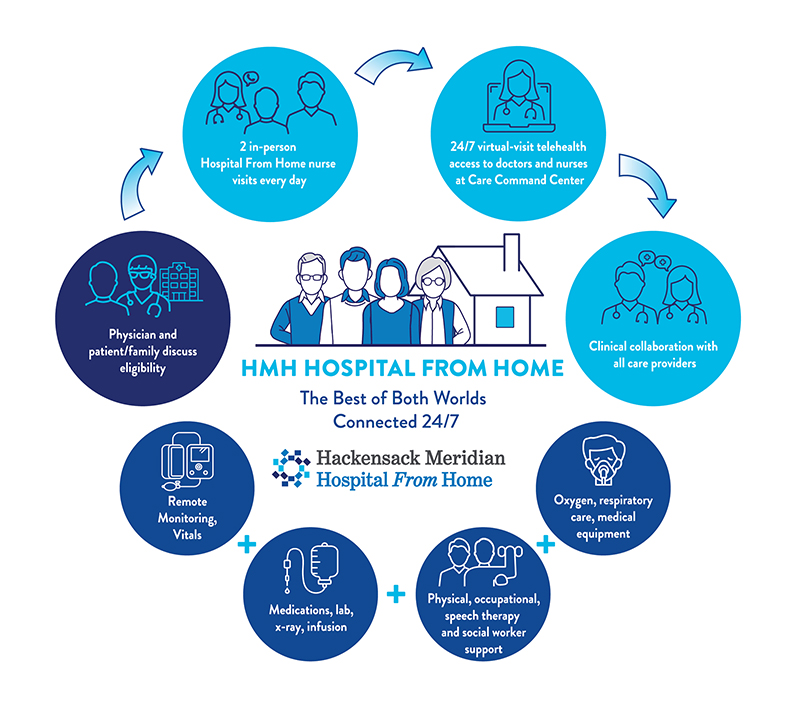
The Hospital From Home program combines the best of hospital-level care with the comforts of home for patients with specific conditions that meet program criteria. Hospital From Home is a care model that brings the expertise, services, equipment and amenities you need for treatment and recovery to your door. The program may be available to some patients as an alternative to being admitted to the hospital, and has been proven safe, effective and patient satisfaction and experience with the program has been exceptional.

Meet Denise and her care team:

The YouTube video on the program.

Eligibility:

If you are eligible for the program and would like to participate, there will be a medical evaluation and assessment. Once admitted to the program, all of the below services will be provided including:

  • Two in-person visits from a nurse every day
  • Daily virtual visits from your attending physicians
  • 24/7 access to our Care Command Center team staffed by nurses
  • Home monitoring and communications technology (delivered, set-up and training on the one-touch, user-friendly communications console)
  • Remote monitoring of vitals signs
  • All medications (including IV and infusion therapy) delivered to your home
  • Rehabilitation services (including physical, occupational and speech therapy)
  • In-home diagnostic services including lab work and imaging
  • Durable medical equipment and supplies including beds, safety and stability aids, wound dressing and more
  • Care management and planning with social workers
  • Respiratory care including delivery of oxygen
  • EMS transportation for urgent care if needed
  • Meals and nutrition
  • Courier services

Hospital From Home – an ecosystem of care covering all your needs

Hospital at Home

This program is currently only available at:

Physician and Nurses- for additional information please contact Kim Scangarella, MSN, RN Director for Hospital From Home at kimberly.scangarella@hmhn.org or at 732-703-0133.

Bloggers Note: I have never used this program before so I have no opinion on it good or bad. Please contact Hackensack Hospital for more information on the program to see if you are eligible for it. This program is only available in certain areas of New Jersey. This information was taken directly from the Hackensack Medical Hospital website and I give them full credit for this information.

Posted in Bergen County NJ Programs, Caregiving Programs, Hackensack Medical Center Programming, Health and Life Support Services, Men's Programming, Senior Services, Support Services for Seniors, Uncategorized, Woman's Programming | Tagged , , , , , , , , , , , , , , | 1 Comment

Hey, Parents: Let’s learn how to Protect your Child-National Child Safety Council

Hey, Parents: Let’s learn how to Protect your Child-National Child Safety Council

Missing Children:

The statistics on the number of children who are reported missing are staggering. Not all missing children are runaways; some children just seem to vanish without a trace.

We cannot always be with our children and we must trust their intelligence and good judgement. We can teach our children to be alert to the world by giving them the tangible knowledge they need to cope with the few times they may find themselves in danger. Perhaps through education, we can prevent a child’s disappearance.

This information provides you with some necessary precautions you can take to help protect your child from being a victim of abduction. Children should be made aware of the dangers but not be afraid.

Parents be Aware:

Abductions usually select a child ahead of time whom they thing will be a easy target. They look for children who walk to school alone, take shortcuts or seem to be alienated from other children. Quite often these people are found watching playgrounds observing children’s play habits.

Self-defense classes or personal safety devices can give a false sense of security. Teach your child at an early age to ask permission before leaving the house or yard. Also, discuss dangerous people, their lures and how to respond in these situations.

10 Preventive Tips:

  1. Teach your children how to use a telephone and a pay telephone to make both a local and long distance calls.

*Make sure they know your full name and theirs.

*Have them memorize your full telephone number including area code.

*Have them practice saying or writing your full address including zip code.

*Instruct them to call home, law enforcement, “0” for operator, “9-1-1” or your local number in an emergency.

2. Update the photos and physical description in the home file on your children regularly; four times a year for children under 2.

*Include information on extra activities and friends, their addresses and telephone numbers.

*Have a set of their footprints or fingerprints taken.

*Be able to locate dental or medical records if necessary.

3. Know where your children are at all times. Never leave them unattended in a public place, car, store or restroom.

*Take note of what your child wears every day.

*Avoid putting their names on the outside of clothing or books (Children may respond more readily to someone who call them by name).

*Encourage children to only play in supervised areas with friends you are familiar with.

4. Be sure your child knows what to do if your become separated while shopping:

*Never look for you or leave the store, go to the parking lot to your car or hide, if scared.

*Go immediately to the nearest clerk and ask for help.

5. Explain to your child who a stranger is. Being polite to adults is okay but they are allowed to say NO when adults ask for assistance.

*Children should never get into or go near the home or car of someone they do not know.

*Children should never take gifts from someone they do not know.

*Be aware of anyone who pay an unusual amount of attention to your children.

*Listen if they do not want to be left alone with someone.

6. Choose a secret code word to use with your children in case of an emergency:

*Explain to only go with someone who knows the word.

*Stress that the word (or words) should be kept secret and change it frequently.

*Instruct your children’s schools or day care centers to notify you immediately if your children are absent and who is authorized to pick them up.

*Try to have the same person every day if possible.

7. In a matter of fact nonthreatening way explain the many tactics possible abductors use to lure children away and how to respond.

*Ask your children to tell you about uncomfortable situations, such as being asked to keep a secret or about meeting any new adults.

*Be alert to any new possessions and their origin.

8. Walk your children’s route to and from school pointing out dangerous spots, such as vacant lots, alleyways etc.:

*Encourage the buddy system and tell them what to do if a stranger follows or approaches them.

*Get to know your neighbors and encourage them to participate in a “safe home” program.

9. Be cautious when selecting anyone who will have responsibility for your children:

*Meet with caregivers and check their references.

*If left home alone make sure children know how to answer the telephone and the door in your absence.

10. Let your children know you are willing to talk and listen to anything they may want to report:

*Never underestimates any fears or concerns they have.

*Children should trust their own feelings and know that you are always concerned for their safety.

Disclosure: The blogger got the information from the pamphlet “Hey, Parents Let’s learn how to Protect your Child” by the National Child Safety Council and I give them full credit for this information. Please check out their website for more information.

Posted in Caregiving Programs, Child Program Services, Children's Programming, Men's Programming, New Jersey Children's Programs, New York Children's Program, Uncategorized, Woman's Programming | Tagged , , , , , , , , , , , , , | 1 Comment

Are you traveling safely?-National Child Safety Council

Are you traveling safely? National Child Safety Council:

  1. Planning Trips: Use an established travel agency. If possible, never travel alone, Get written information about all aspects of travel packages, before booking including cancellation policies. Ask about extra charges, such as port taxes. Reject any travel ‘prize’ that requires a fee or processing charge.

Secure reservations with a credit card (be careful giving out this number and/or a checking account number) to avoid being stranded in unfamiliar or unsafe surroundings. This documentation may be helpful in case of a dispute. Register using a business address instead of a home address.

Checking In:

*Ask about security features and how to use them and any local ‘con games’ tourists encounter.

*Know your license plate number to avoid going outside along to get it

*Ask about safe areas for jogging, walking, shopping, etc. Ask for a map. Ask when taxis or public transportation stop running.

*Store luggage in a locked room if your room is not ready.

*Ask the front desk for necessities first instead of going out in an unknown area.

*Never leave magazines with a home address in your room.

*Have someone go with your if you feel uneasy about sending a fax, going to the laundry, pool or exercise facilities alone or tell the front desk where you will be.

*Never use health club facilities that are totally enclosed or unsupervised.

*Ask the front desk to not release your room number with anyone.

2. Request a Room:

*In or near the main building: on the concierge or key service floor (if there is one) especially if you are traveling alone.

*That faces inward toward other rooms or towards the lobby.

*That does not have a window easily accessible from the street or roof, preferably on the second floor but no higher than the seventh.

*Near a fire exit but away from stairwells, elevators, ice and vending machines and basements or garbage.

*Near (but not next to) the elevator to help avoid long walks down hallways.

When you get your room:

*Do a quick inspection: (Closets, bathroom, behind show curtain, under beds etc.) for hiding places or anything out of place. Trust your instincts. If you do not feel safe or if someone was in the room, leave immediately. Report anything suspicious and ask for another room, cabin or seek another hotel/motel.

*Never enter if someone is watching or loitering nearby or enter quickly and report the person to the front desk. Walk by suspicious looking people confidently. Avoid isolated areas like stairways. Go where there are other people.

*Never let a stranger show you to your room or carry your luggage.

*Read or watch security, fire or other emergency videos.

There are 65,000 hotels and motels in the US.

3. Security Measures:

Entry Doors:

*Look to see if your door is solid wood or metal, has a sturdy deadlock with a one-inch throw bolt and a reliable key system. Be sure it is visible to the hallway.

*Always use the deadbolt and safety latch when in your room. If the lock looks tampered with, ask for another room or use another hotel/motel.

*Make sure electronic card-access locks are changed after each use.

*Make sure you can push a button on the inside knob that will block out all keys. (former guests or housekeeping) while you are inside.

*Be sure windows with secure locks open and close easily from the inside.

*Make sure all doors are locked securely, including the patio or balcony. Use the extra lock or a stick on sliding windows or doors.

*Be sure connecting doors are locked and secure.

*Make sure your balcony cannot be accessed from the ground or the room next door.

*Never rely on door chains or swing bars for safety when answering the door. Use the wide angle peephole.

*Close the curtains completely, especially in the evening or if you will be out.

*Hang the “Do Not Disturb” sign when you leave and turn the light, radio or TV to discourage burglars.

Room Keys:

*Request a key without your room number on it (in case it is lost or stolen). Report missing or lost keys immediately and move to a different room. Never write your room number on your key.

*Keep your key in a safe place and never leave it unattended.

*Never leave your key in the room or the door. Never give your key to others.

Elevators:

*Do not enter the elevator if it is occupied by someone you consider suspicious. If someone gets on who makes you feel uneasy, get off.

*Always stand next to the controls.

*If someone is watching when you enter, press several floor buttons so they do not know which floor is yours. Report the incident if you felt uncomfortable.

Telephone Tips:

*Know how to call the front desk and dial 9-1-1 quickly. You may need to use an outside line to dial 9-1-1.

*Memorize your room number, the facility name and its location.

*Hang up immediately if you get unwanted, harassing or threatening telephone calls. Notify the front desk and proper authorities.

*Never give a credit card number over the phone to someone who calls your room.

4. Protecting your Valuables:

*Keep large amounts of money out of sight. Never count it in public. Put it back in your wallet before turning and leaving the cashier.

*Store valuables or important documents (passport, airline ticket, credit cards, large sums of money, jewelry) in the safety deposit box at the front desk and get a receipt. Use a room safe for items of moderate value.

*If there is no room in the safe, put valuable in a money belt that you wear or bring along a “portable safe.” These come in many forms: hollow books, shoes with hollow heals, suitcases with secret compartments etc.

*Never draw attention to yourself by traveling with expensive jewelry or furs. Consider reproductions. Turn large stone rings around or cover with a band aid.

Visitors:

*Use the peephole. Call the front desk to confirm visitors, even if they say they are with room service etc.

*If you are expecting someone, prearrange an exact time of arrival and some form of identification; a secret knock, business card under the door or a phone call from the lobby.

Traveling with Children:

*Never leave children alone, especially near window/door screens or on balconies.

*Be sure hotel loaner cribs, play yards, etc. meet current safety standards (not recalled) and are in good repair.

*If traveling along or with small children, use valet service and ask for a hotel escort.

Disclosure: The blogger wanted to note that this information was taken from a pamphlet entitled ‘Are you Traveling Safely?’ by the National Child Safety Council and gives them full credit for the information. Please check out their website for more information and other programs that they promote.

Posted in Caregiving Programs, Child Program Services, Corporate Programming for the public, Men's Programming, New Jersey Children's Programs, New York Children's Program, Scamming and Fraud Programming, Senior Safety Programs, Senior Services, Uncategorized, Woman's Programming | Tagged , , , , , , , , , , , , , | 1 Comment

PSE&G Important natural gas safety information

PSE&G Important natural gas safety information

Educate your family about natural gas leaks.

Natural gas is a clear and efficient fuel source used safely in millions of American homes and businesses. But as with any flammable material, leaks that do occur can be dangerous.

PSE&G wants you to be aware of how to detect a gas leak and what to do if you suspect a leak in or around your home.

If you think there is a leak:

*Smell: Don’t take any chances. If you think you smell a gas leak or see other signs, assume it is a leak.

*Leave: Leave your home immediately and get as far away as you can. If you notice the odor outside, leave the area where you suspect the leak is coming from.

*Call: Once you are in a safe environment, at least 350 feet away from the suspected gas leak area-call 911 or PSE&G at 1-800-880-PSEG (7734)

Protect your family against carbon monoxid.

What is carbon monoxide?

You can’t see or smell carbon monoxide (CO). Small amounts of CO are in the air whenever fuel (such as oil, gas or coal) is burned. These amounts are usually not harmful. However, when fuel-burning appliances and equipment are not working properly, too much CO can build up in the air and cause CO poisoning.

Symptoms of CO poisoning:

Symptoms can occur immediately or gradually after long-term exposure.

*Headache

*Weakness

*Dizziness

*Vomiting

*Nausea

*Confusion

If you suspect CO poisoning:

*IF you think there are high levels of CO in your home, go outside!

*If there is a medical emergency, such as someone falling unconscious, take the person outside to fresh air and call 911.

*Call PSE&G’s emergency service line at 1-800-880-PSEG (7734). Wait outside until help arrives.

How to prevent CO poisoning:

*Install carbon monoxide detectors in every area of your house. Regularly check the batteries.

*Make sure that all fuel-burning appliances are maintained and are operating properly.

*Do not allow vehicles or any gasoline powered engine to idle in a garage or enclosed space. CO can drift inside and create a hazardous situation.

How to know if there is a leak:

Because natural gas is odorless and colorless, a distinctive odor, like rotten eggs, is added to it to help in the detection of leaks. Make sure everyone in your home is familiar with this odor.

There are reliable ways to detect a gas leak:

*Hearing a hissing sound.

*Seeing bubbling in puddles.

*Smelling the odor of rotten eggs.

A commitment to safety:

PSE&G is deeply committed to the safety of our customers, our employees and the communities we serve. As your natural gas provider, we want to make sure you are prepared in the event of a gas emergency. Share this information with everyone in your household and keep it in a handy place to refer to quickly if you suspect a problem.

Visit our website for information about gas safety, including:

*Proper storage of flammables.

*Safe digging around your home.

*Gas heaters & Appliance safety.

https://nj.pseg.com/safetyandreliability/gassafety/gashomesafety#:~:text=If%20you%20suspect%20there%20is,7734)%20from%20a%20safe%20distance.

pseg.com/GasSafety.

Disclosure: The blogger wants to note that this information was taken directly from the PSE&G pamphlet on gas safety and gives them full credit for the information. Please either call the above 1-800 number or reach them through their website for more information.

Posted in Corporate Programming for the public, Health and Life Support Services, Men's Programming, PSE&G Programs, Senior Services, Uncategorized, Woman's Programming | Tagged , , , , , , , , , , , , | 1 Comment

Is your ATM Safe?

Is your ATM Safe?

Drive up safety, Check Cashing Stores, Safe Transactions and Tips for Lenders.

Security:

Select a well-lighted, busy ATM that is protected yet visible from the street. Try to use an ATM during daylight hours. Avoid using ATMs located at rear entrances or surrounded by shrubbery or trees. To prevent a thief from finding enough privacy to corner you, use an ATM that has:

Most ATM robbers claimed to have a concealed weapon. Most ATM victims are women who were alone at the time and never saw the robber coming.

*A stationed guard

*Working security cameras

*An emergency telephone

*A door that locks

*An enclosed vestibule with windows

Drive-Up Safety:

When using an ATM, never open the door to anyone. Use a drive-up ATM instead of a walk-up where robberies are most likely to occur.

*To avoid being blocked in when using a drive-up machine, do not pull forward until the car ahead of you has left.

*Lock your doors and windows.

*Keep your care in gear with your foot on the brake.

*If you must use an ATM at night, ask someone to accompany you and stand guard.

*If using a walk-up ATM, lock your doors behind you.

In 1/3 of all ATM card frauds, the cardholder wrote their PIN on their ATM or on slips of paper kept with their card.

Check Cashing Stores:

*Be aware of who is around you so you know if you are being followed after cashing a check.

*Do not count out large quantities of cash in open view.

*Park in areas that are well lit.

*Avoid routine, such as cashing a check at the same time and location each week.

*Avoid wearing expensive jewelry when obtaining cash.

Safe Transactions:

When someone is using the machine, stand back to allow privacy, then follow these tips.

*If you have difficulty inserting your card into the ATM slot, STOP. Go to another ATM and report the problem to your bank.

*Once your transaction is complete, put your money away immediately. Count it later.

*Always take your receipt and verify each transaction. If you have an unexplained transaction, contact your financial institution immediately.

*Be cautious if approached after conducting a transaction.

*If something makes you uneasy, terminate the transaction and go to another ATM.

*Go to a public place and stay there at least 15 minutes if you think someone is following you.

*Be wary of anyone who crowds you or tries to view your transaction. Stand between the ATM and the people behind you in line.

*Never accept help from anyone .

*Surrender your card and money upon demand if you are held up.

*Report any lost or stolen card to your bank and your local law enforcement department.

ATM Safety:

An Automated Teller Machine (ATM) is an electronic terminal that allows you to bank 24 hours a day. By entering a Personal Identification Number (PIN) you can withdraw cash, make deposits or transfer funds between accounts using an ATM card. Electronic Fund Transfer (EFT) uses computer and electronic technology as substitute for paper transactions. Protect yourself from theft while using an ATM.

*Memorize your PIN, then keep it a secret. Never write your PIN on your ATM card, a deposit slip, envelope or postcard. Never carry your PIN number on your person.

*Choose a PIN other than your birthdate, phone number or Social Security number.

*Never discuss your account with anyone over the phone or in person.

*Never allow anyone to use your card or PIN or help you with a transaction.

*Have your card ready and the forms filled out. Never approach an ATM holding out your transaction card or deposit.

*Vary the time and location for using an ATM.

*Shield the screen and key pad from view.

*Visually inspect the ATM for signs of tampering or homemade devices (illegal card-reading devices or scanners placed over the card slot, unauthorized hidden cameras on card racks, etc.). Report any suspicious to your banking institution.

Tips for Lenders:

Protect your ATMs through environmental design, lighting, landscaping and location. ATM sites should be inspected regularly to ensure that safety features have not become compromised. ATM operators, law enforcement and bank regulators should all share responsibility for monitoring compliance.

*Install proper lighting at and around ATMs, including all adjacent building corners and nearby parking places. This allows users to see anyone suspicious near the ATM.

*Keep trees and shrubbery trimmed to remove potential hiding places.

*Remove obstacles such as dumpsters, benches or walls that obstruct a clear view of the ATM.

*Install mirrors on ATMs and on adjacent building corners.

*Install ATM where there is a lot of natural surveillance such as vehicle and pedestrian traffic or near local law enforcement.

*Relocate, close or limit the hours of operation and ATMs at high risk sites.

*Install and monitor surveillance cameras at and around ATMs.

*Install devices such as a panic button, telephone or microphone that allows victims to summon police during a robbery.

*Routinely inspect ATMs for unauthorized hidden cameras or illegal card devices.

*Assign security guards at high-risk ATMs.

*Prohibit loitering and panhandling.

*Require ATMs to be located in enclosed vestibules with doors that lock.

*Set daily cash-withdrawal limits.

Most ATM robberies occur between Midnight and 4:00am.

Bloggers Disclosure: This information was taken directly from the National Child Safety Council pamphlet and I give them full credit for this. Please call the National Child Safety Council for more information on this and other subject matters.

Posted in Men's Programming, Scamming and Fraud Programming, Senior Safety Programs, Senior Services, Support Services for Seniors, Uncategorized | Tagged , , , , , , , , , , , , , | 1 Comment

“Hey Parents, Let’s learn about Dangerous Situations”-National Child Safety Council

“Hey Parents, let’s learn about Dangerous Situation”-National Child Safety Council

Personal Safety: Everyone has a right to personal safety. Teach your child about these rights and the responsibility that goes with them. Help reduce your child’s safety risks.

  1. Set aside time to talk to your child about dangerous people and situations.

*Talk to your child on his own age level, using words and concepts that he will understand.

*Be straightforward, yet caring.

*Never use scare tactics.

*Explain without frightening the sensitive child.

2. Listen to your child. Create an open, caring atmosphere where your child will be encouraged to talk about sensitive matters.

*In most cases, children will not report an incident where someone has approached them in a way that has made them uncomfortable.

*Often children deny any wrong-doing for fear that their parents will be angry and punish them for what has happened.

3. Never underestimate any of the fears or concerns your child may have.

*Pay close attention if someone pays unusual attention to your child.

*Let your child know that any such situations are not his fault and that he will not be punished.

*Seek professional help if needed.

*Keep a home file on your child including up to date photos and other personal information.

Dangerous People:

Children are often taught to respect and obey adults. The abductor or exploiter may take advantage of his or her position as an authoritative or family figure to disarm and seduce children.

Children can be polite and friendly but if a situation seems suspicious, they should ask these questions:

*Have I ever seen this person before?

*Do I know this person’s name?

*Do my parents know and approve of this person?

*Does this person make me feel uncomfortable?

*Does this person ask me to keep secrets?

Dangerous people can be anyone and may not always be strangers: a potential predator might be a friend’s parent, school personnel, a neighbor, a family member or a friend: it’s rarely a complete stranger.

Teach your child to never go with anyone who doesn’t know their code word: they should check with you or a trusted adult before going anywhere with anyone, even someone he knows well.

Teach your child to be wary of anyone who makes them feel uncomfortable: they should trust their intuition and act on it by running away screaming to attract attention. Practice yelling for help.

Explain that children should not be afraid of all strangers: they should be cautious only of those who pay extra attention or want something from them.

Role play: discuss possible scenarios and safe responses. Consider that abductors are now more physical in their educations.

The Lures:

Abductors use many tactics to lure children away. They appear friendly causing children to let their guard down. They may ask children for:

*Directions or assistance, pretending to be hurt.

*Help finding a lost pet.

*Help mailing letters or carrying packages to a car or into a home.

Teach your child that adults should only ask other adults for help, not children. They should be suspicious if someone they do not know:

*Calls him by name.

*Presents himself as an authoritative figure like an officer, firefighter or clergy member.

*Says that his parent is hurt or sick and has asked that the child be given a ride.

*Offers him gifts or money.

Never place your child’s name on the outside of clothing or personal items.

Know your child’s friends and their parents.

Check your child’s route to and from school: let the school know who is authorized to pick up your child. Request to be contacted if your child is absent without an excuse.

Have your child practice memorizing license plates and identifying stranger’s features comparing them to someone they know.

Increases the risk of abduction:

*Being left unattended, unkempt or neglected.

*Being from a broken home, having parents going through a divorce or separation, parents who are sexually promiscuous or a single female parent who gives trust to male friends.

*Having several siblings.

*Being starved for attention or affection.

*Being slight in build.

*Playing or traveling alone, especially at night.

*Frequenting video arcades.

*Smoking at an early age.

Missing Children Categories:

Nonfamily abduction: is the unlawful taking of a child by someone who is not a parent, relative or legal guardian. Nonfamily abduction is commonly called stranger abduction; however the term ‘stranger’ can be misleading because many children abducted and exploited by persons with whom the have had some familiarity or relationship but who are not necessarily know to their parents.

Family abduction: is the unlawful taking of a child by a parent (usually a noncustodial) or family member from the legal custody of another, usually a parent.

Runaway children: are those who voluntarily abandon parent(s) or other legal guardians.

Throwaway children: are those who are either abandoned or forced out of their homes by parents or legal guardians. They include children who are allowed to come and go as they please; children whose mothers and fathers have totally neglected their parental responsibility.

One thing common in all cases of missing children is the danger of physical and emotional injury and the threat of sexual exploitation of children who are out of lawful and caring custody. The longer children are gone from their homes, the greater the probability that:

*they will not be reunited with the family in a stable home environment.

*they will be victimized on the streets.

Child Care:

*Research the program or individual. Check references.

*Check out professional qualifications and the backgrounds of employees.

*Talk with others who utilize this individual or program.

*Watch how your child interacts with a prospective sitter.

*Ask about policies on supervision and discipline.

*Make sure there is an open invitation to drop by unannounced and that parental involvement is encouraged.

*Be specific about who may pick up or visit your child.

*Be sensitive to changes in your child’s behavior. Trust your instincts if something seems wrong, act!

Special Family Issues:

*If you and your spouse are not living together, make sure your child knows the exact days he is to spend with each parent.

*Explain to caregivers that they should not be fooled by a divorced or separated parent who says he or she has come to get the child because the other parent doesn’t want them anymore or tells other lies.

*Obtain a passport for your child. It is difficult to get a second one for the same person or to transport a child out of the country without one.

Blogger Disclosure: This information was taken directly from the pamphlet “Hey Parents: Let’s learn about Dangerous Situations” by the National Child Safety Council and I give them full credit on the information. Please contact the National Child Safety Council for more information on their programs.

Posted in Behavioral Health and Psychiatry Services, Child Program Services, Children's Programming, New Jersey Children's Programs, New York Children's Program, Uncategorized | Tagged , , , , , , , , , , , , , | 1 Comment

Safe Syringe Disposal: NJ Department of Health

Safe Syringe Disposal: NJ Department of Health

Consumer, Environmental & Occupational Health Service

PO Box 369

Trenton, NJ 08625

(609) 826-4941

http://www.nj.gov/health

https://www.nj.gov/health/

Safe Syringe Disposal

New Jersey NJSA 2C:36-6 et seq, permits persons aged 18 years and older (with valid photo ID) to legally possess up to ten hypodermic needles and syringes without a prescription from licensed pharmacies. The statute also requires safe deposal of the needles and syringes to avoid injury or disease transmission.

Improper disposal of needles and syringes may cause risks to others. Used needles and syringes can transmit HIV, Hepatitis B, Hepatitis C and other diseases. Loose needles, syringes and other medical sharps should be collected in heavy duty plastic containers. Never flush them down the toilet, place in recycling bins or in household garbage. This can be a source of disease transmission to both humans and animals.

Disposing of Syringes and Needles Safely

Used needles and injecting equipment are dangerous to other people and pets if not disposed of safely. They can injure people and spread infection.

To dispose of used syringes and needles safely:

  1. Place used syringes and needles into a FDA-approved sharps container or into a heavy-duty plastic container, such as a laundry detergent or bleach bottle. The bottle should be sturdy, puncture-resistant and should not leak.
  2. Close the screw on lid tightly and label the sealed container as “Do not Recycle-Container Sharps”.
  3. Don’t use coffee cans as plastic lids can come off easily. Don’t use glass bottles which may break.

DO NOT put a plastic container with used needles and syringes out with the recyclables.

DO NOT try to remove, bend, break or recap needles used by another person. This can lead to accidental needle sticks, which may cause serios infections.

Pet owners who use needles to give medication to their pets should follow the same disposal guidelines used for humans.

Check with your local health, sanitation or public works department or trash collector before you dispose of used needles and syringes in your household trash.

The New Jersey Safe Syringe Disposal Guide provides information for individuals who use syringes, needles or other equipment about proper disposal of these items. To get a copy of The Guide call the NJ Department of Health’s Public Health Sanitation and Safety Program at (609) 826-4941 or go to http://www.nj.gov/health/phss.

Many hospitals accept used needles and syringes when put in containers using the steps listed. Refer to the Safe Syringe Disposal Guide for specific locations and contact information.

The U.S. Food & Drug Administration (FDA) website has more information for the safe disposal of needles, syringes and other medical sharps at:

http://www.fda.gov/safesharpsdisposal

https://www.fda.gov/medical-devices/safely-using-sharps-needles-and-syringes-home-work-and-travel/sharps-disposal-containers

New Jersey Resources:

New Jersey Addictions hotline:

*1-800-238-2333 or 211

*Hotline is available 24/7

*Trained telephone specialists educate, assist, interview and/or refer individuals and families battling addicitions.

*Calls are free and confidential.

*www.nj.gov/humanservices/das/home/index.html

*www.nj211.org

New Jersey Safe Syringe Disposal Guide

*www.nj.gov/health/phss

New Jersey HIV/AIDS hotline

*1-800-624-2377

*Information about HIV/AIDS and other related information including syringe access programs

*www.nj/gov/health/aids/index.shtml

*Disclaimer: This information was taken from the NJ Department of Health pamphlet on Safe Syringe Disposal, and I give them full credit for the information. IF you need any additional information, please check out their website.

Posted in Drug and Alcohol Abuse Programs, Drug Assistance Programming, Health and Life Support Services, Men's Programming, New Jersey State Program, Senior Safety Programs, Senior Services, Uncategorized, Woman's Programming | Tagged , , , , , , , , , , , , | 1 Comment